Collaborative research spotlights August 2026
A good share of the lab’s output shows up as contributions to work led by collaborators. Five such papers have appeared since early summer, and each is worth a look:
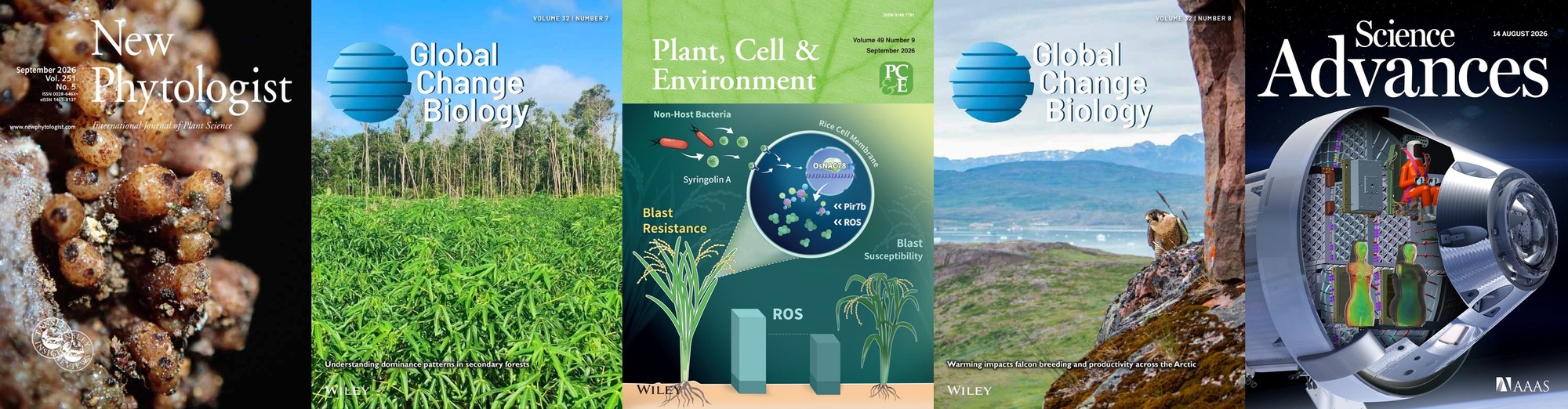
Soil fertility controls on tropical forest productivity and mortality (New Phytologist), led by Michelle Wong and Evan Gora. Aboveground productivity rises with soil fertility, but biomass does not rise proportionally — likely because mortality climbs too. The paper lays out a mechanistic framework for that disconnect and a roadmap for pinning it down.
Land-use transitions and carbon emissions of aquaculture expansion in the Brazilian Amazon (Science Advances), led by Felipe Pacheco with Alex Flecker’s group at Cornell. Amazonian aquaculture pond area grew 450-fold between 1985 and 2022, mostly on existing pasture (87%) rather than forest (5%). In Rondônia, production could double by converting just 1.2% of degraded pasture — if siting policy steers it there.
Multi-model ensembles in ecosystem modeling (Global Change Biology), led by Kaiyu Guan. A perspective on a habit the field has slipped into: stacking models together and reading the spread as uncertainty. The authors argue that ensembles are only decision-grade when built on rigorous model intercomparison and co-designed with the people using them, since a poorly built ensemble mostly manufactures confidence.
Disentangling thermal and hydraulic drivers of stomatal conductance under hot versus dry VPD (Plant, Cell & Environment), led by Aaron Potkay and Xue Feng, with Rong Li and Xiangtao Xu as co-authors. Rising VPD is not one signal: dry VPD (low humidity) imposes hydraulic stress that raises water-use efficiency and closes stomata quickly, while hot VPD (high temperature) does the opposite. Of three optimization models tested, only the Generalized Stomatal Optimization model reproduced both responses.
Water limits radial tree growth more than light in an everwet subtropical forest (Global Change Biology), led by Laura Boeschoten and María Uriarte. Two years of hourly dendrometer data from 35 trees in a forest receiving 3500 mm of rain a year overturn the standing assumption that growth there is light-limited: soil moisture and evaporative demand governed whether trees grew at all, with light shaping only how much once water was ample.
The full publication list lives on the Research page.